M45 on the Main Viewer
My Pleiades image is a favorite kind of target: immediately recognizable, scientifically rich, and perfect for the STNG/LCARS console treatment I have been building around my astro gallery.
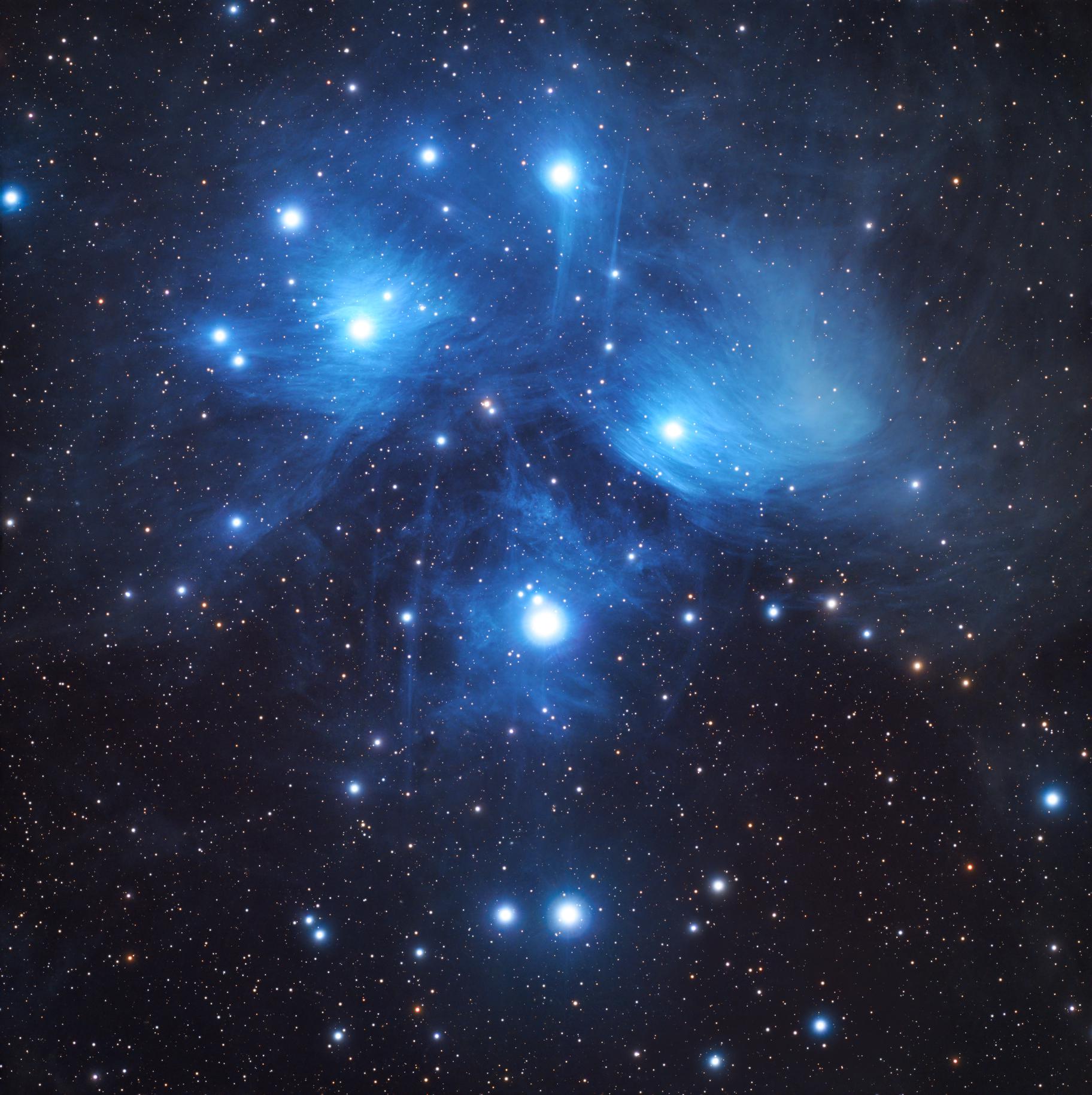
M45, the Pleiades, is one of those targets that can make deep-sky imaging feel less abstract. You do not need a catalog number to feel it. It is a small blue swarm in Taurus, bright enough to catch with your eyes on a good night, but surrounded by the kind of dusty reflection nebulosity that only starts to reveal itself when the camera keeps listening.
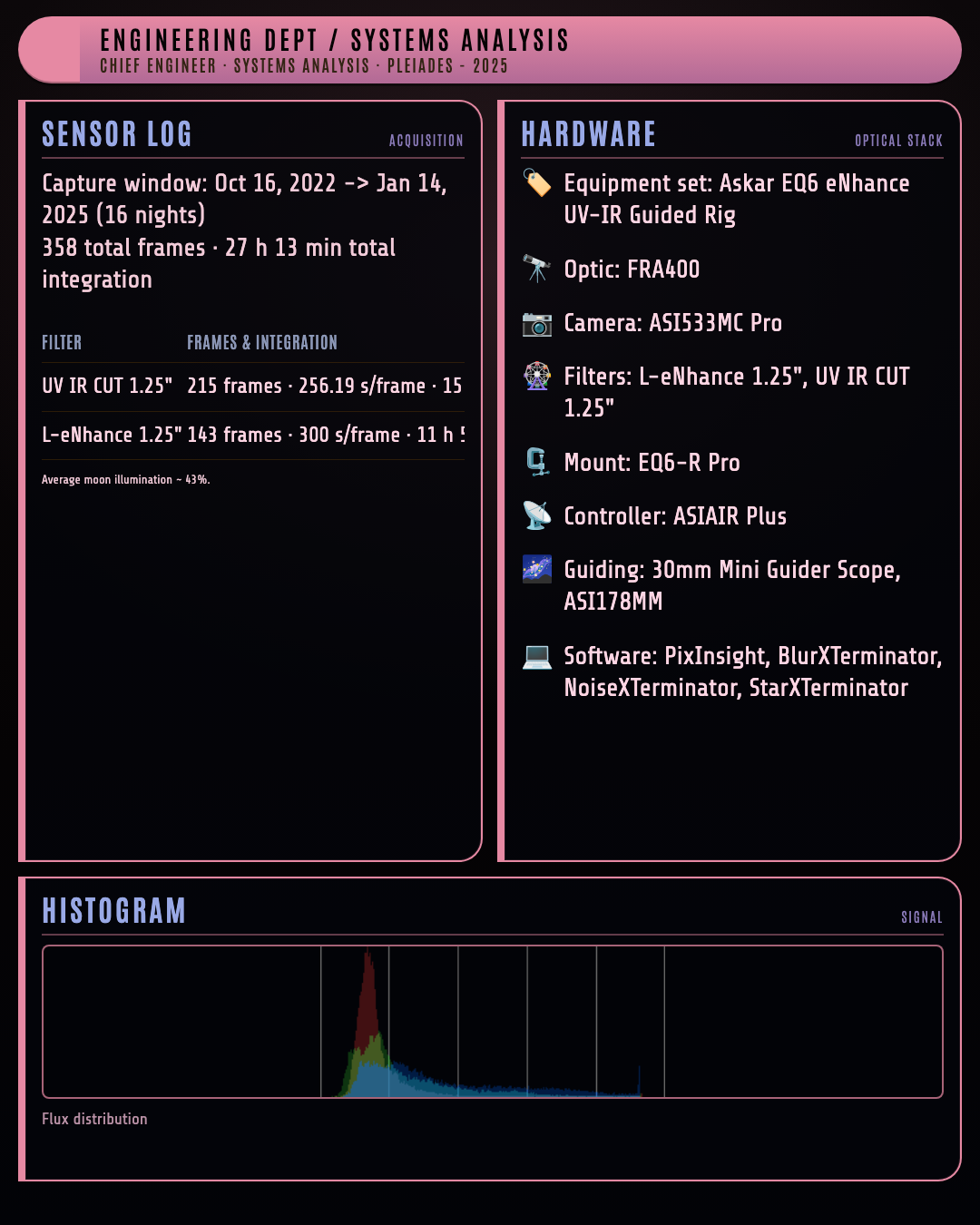
This version, Pleiades - 2025, combines 358 subframes into just over 27 hours of integration. The data spans 16 capture dates from October 2022 through January 2025, which gives the finished image a nice personal time signature. It is not just a picture of a star cluster. It is a three-year return to the same patch of sky.
Integration
Subframes
Nights
Capture span
The target
The Pleiades are young, hot stars moving through interstellar dust. The blue glow is not the cluster burning a nebula from within in the way an emission nebula lights up hydrogen. It is reflected starlight, scattered through dusty material around the cluster. That is why the image has that electric, frosted look: hard points of stellar light wrapped in soft blue structure.
The named stars give the object its mythic texture too: Alcyone, Maia, Merope, Electra, Atlas, Pleione, Taygeta, Celaeno, and Asterope. The gallery record also catches the smaller catalog fingerprints around them, including the Merope Nebula, Maia Nebula, IC 349, NGC 1432, and NGC 1435. It is a familiar target, but it is not a simple one.
The capture
The working stack was the Askar FRA400, ZWO ASI533MC Pro, EQ6-R Pro, ASIAIR Plus, 30mm mini guide scope, and ASI178MM guide camera. The filters split between UV/IR Cut and L-eNhance data: 215 UV/IR Cut frames and 143 L-eNhance frames. Processing ran through the usual PixInsight lane with BlurXTerminator, NoiseXTerminator, and StarXTerminator in the toolchain.
The long time span matters. It is tempting to think of an astro image as one night of work, but a lot of backyard imaging is persistence, bookkeeping, weather luck, and knowing when old data can still be made useful. M45 rewards that. The more time you give it, the more the dust stops being background and starts becoming the subject.
The theme
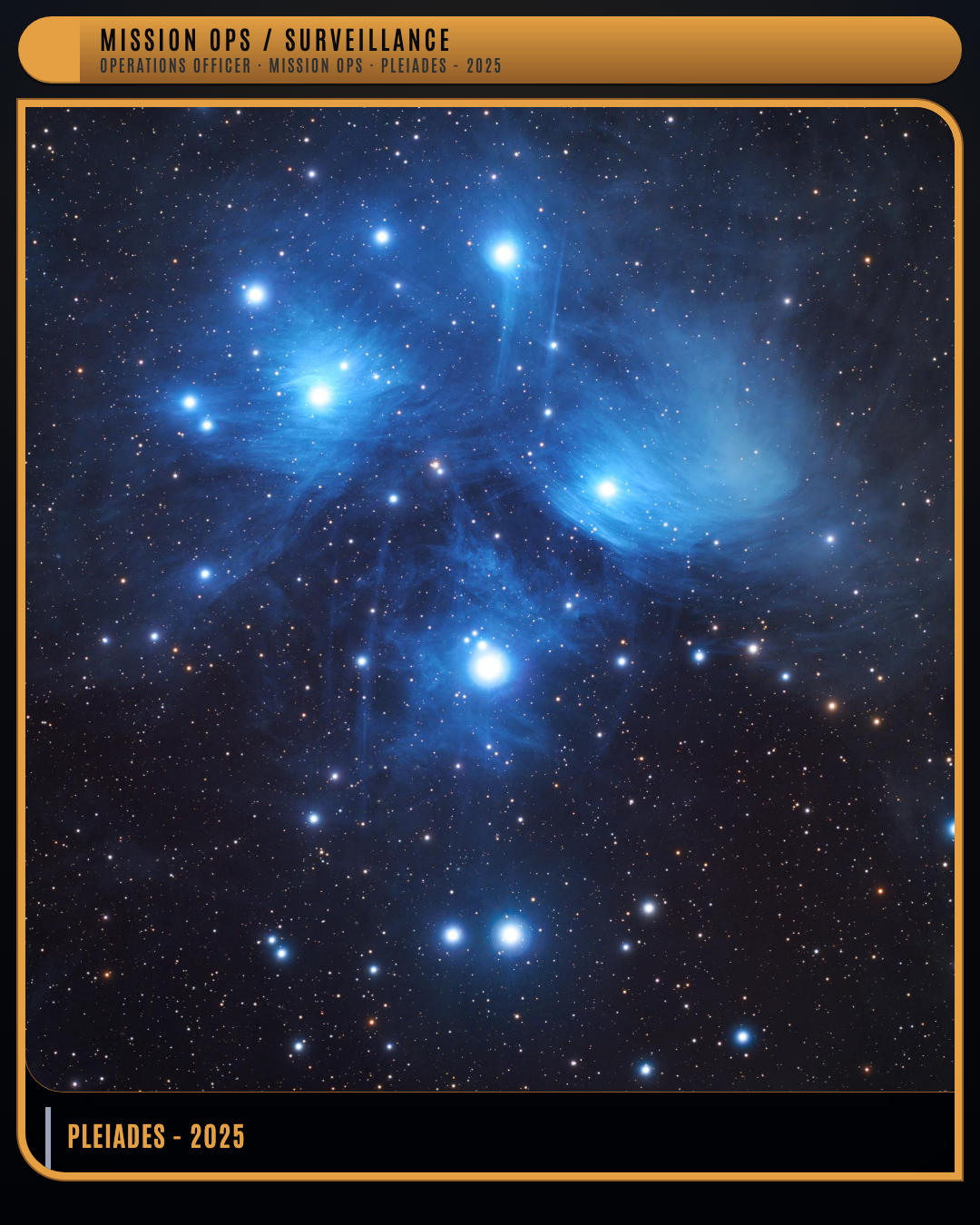
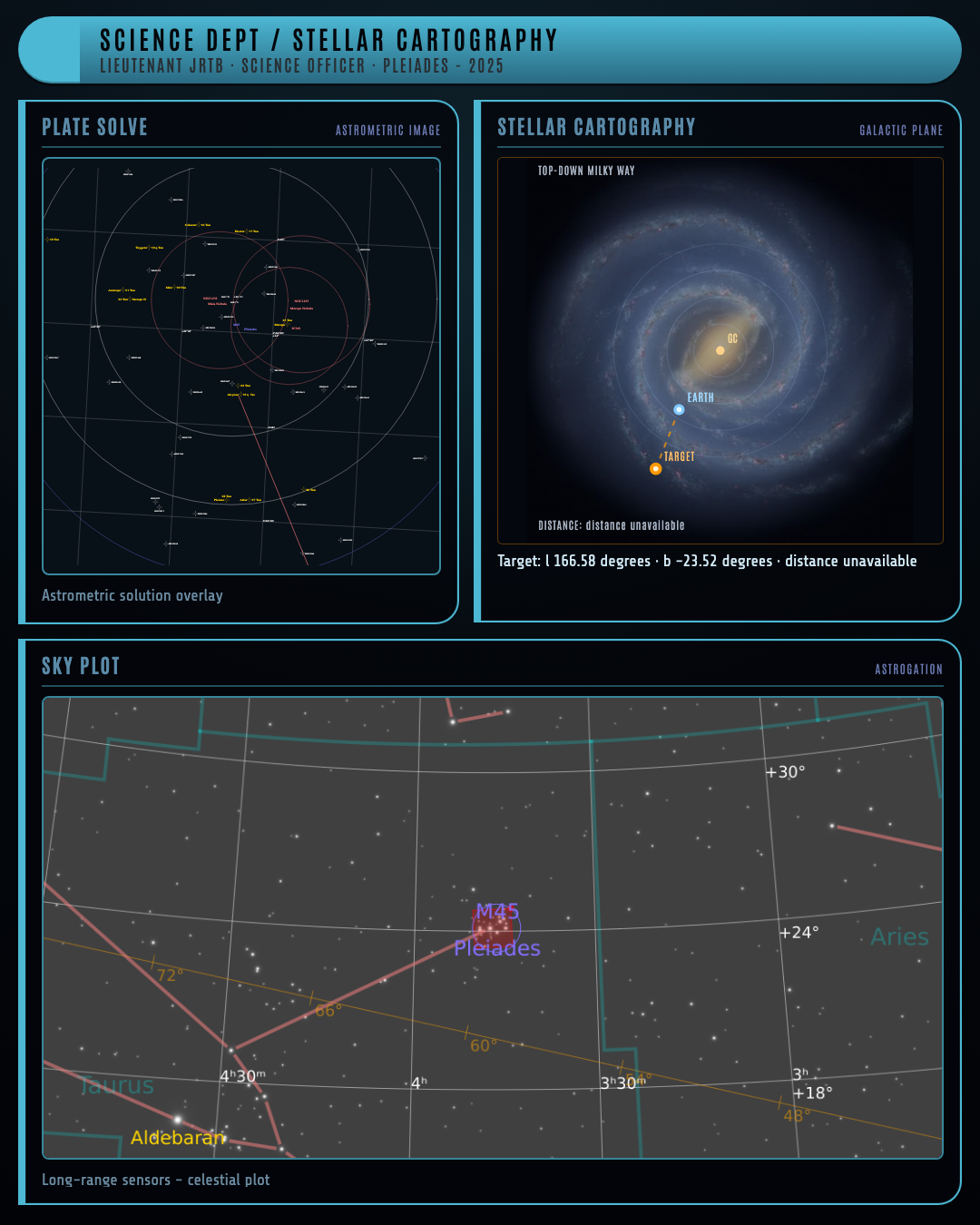
The other part of this image that makes me grin is the presentation layer. The astro gallery is currently wearing an STNG-inspired LCARS skin: command bars, target selectors, nav fixes, sky plots, histogram panels, hardware readouts, and little bits of ship-console theater around real astrophotography metadata.
That has been the key constraint: the interface can be playful, but the data cannot cosplay. Coordinates, capture totals, filters, equipment, solve status, and target descriptions all come from the image record. The fiction is in the frame: "main viewer," "sensor log," "stellar cartography," "mission ops." The facts stay facts.
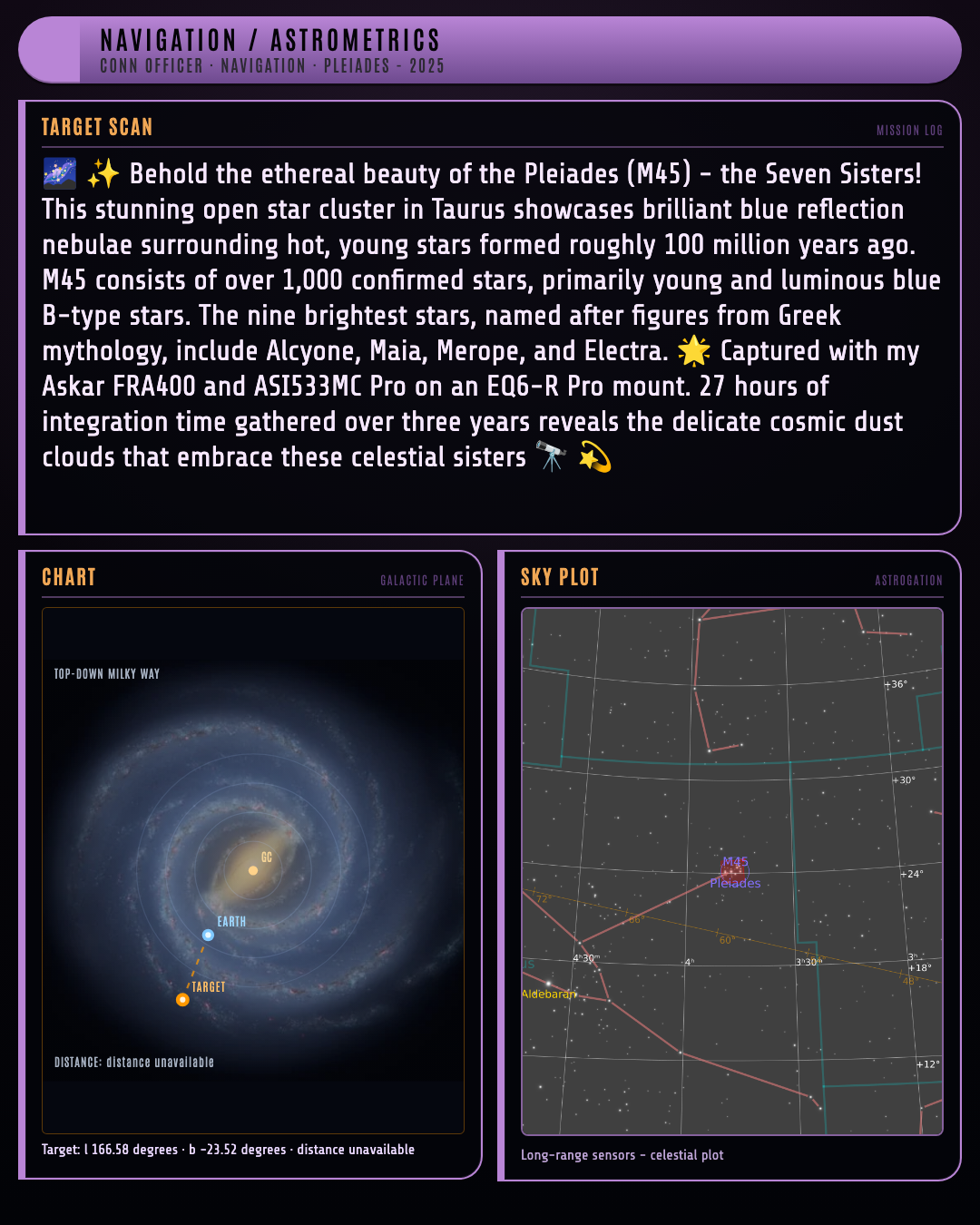
Why this framing works
Astrophotography already has a lot of instrument-panel energy. There are coordinates, exposure logs, calibration choices, weather constraints, guiding stats, solved images, histograms, and catalogs. LCARS gives that density a visual language that feels like it belongs to a ship, but also to the real act of trying to understand a faint thing from a backyard.
For M45, that framing is especially apt. The Pleiades are not an obscure smudge. They are a landmark. The console treatment lets the image operate at two levels at once: as a pretty finished photograph, and as a target with a history, position, capture plan, equipment stack, and scientific context.
The best version of this gallery is not just a wall of finished images. It is a bridge console for my own little archive of the sky.