From BASIC to Websites to Apps to Agents: The Next Wave of Custom Software
Agentic development is making personal software practical again: tools shaped around one life, one workflow, and one set of obsessions.
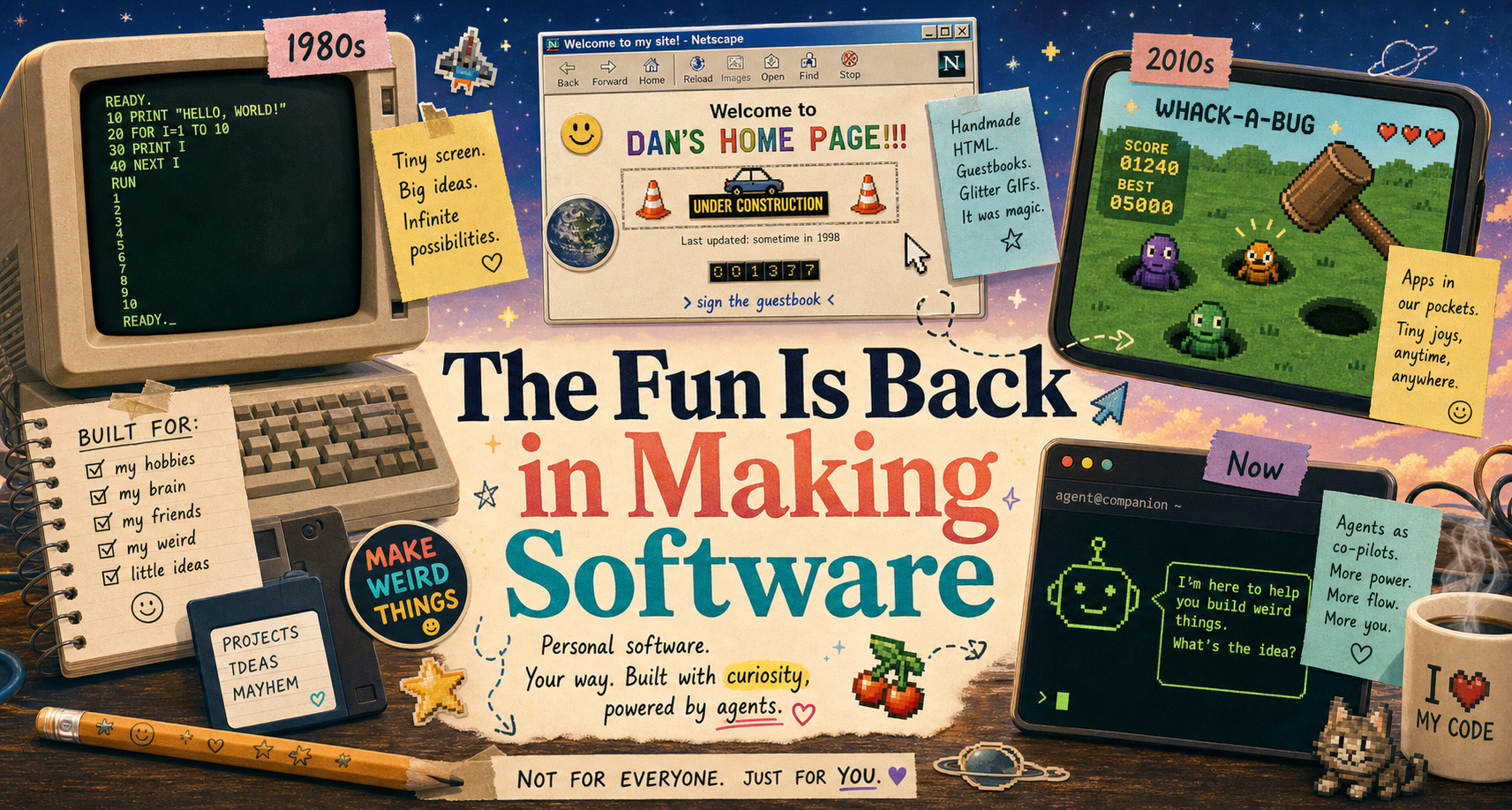
BASIC
Websites
Apps
Agents
Over the last year, I have found myself doing something that would have sounded wildly impractical not long ago: rebuilding pieces of the software I already use, but tuned precisely to my own life.
Not because the existing products are bad. Many of them are excellent. I use them because they solved real problems first. But there is a difference between software that serves a market and software that feels like it was made for your exact archive, your exact workflow, your exact weekend, your exact telescope setup, your exact family.
That distinction has started to matter again. Agentic development is changing the cost and feel of making software. It is turning "I wish this existed" into something closer to "let me make my version of it."
"I wish this existed" -> "let me make my version of it"
The pattern keeps repeating
Every few decades, computing gives individuals a new creative surface.
In the 1980s, BASIC made the home computer feel personally programmable. You could type a few lines, press run, and make the machine respond to your imagination. It was rough, constrained, and magical.
In the 1990s, websites did something similar for publishing. Suddenly anyone could carve out a little place on the internet. The best sites were specific, handmade, oddly personal, and full of decisions no product committee would have approved.
In the 2010s, mobile apps made software feel intimate and constant. But the economics shifted. App stores, platforms, venture-backed SaaS, and subscription bundles professionalized the space. We gained polish and convenience, but lost some of the sense that computers were ours to shape.
Now agents are opening the next surface. The new thing is not just faster coding. It is a lower-friction loop between intent, implementation, feedback, and refinement. You describe the outcome, inspect what comes back, correct the shape, and keep going.
What changed this time
The obvious story is productivity: agents can write code, wire up APIs, refactor UI, generate tests, explain failures, and move a project forward at surprising speed. That matters.
But the deeper shift is imagination. When the cost of trying drops, you start asking different questions.
You stop asking whether a niche workflow deserves a company. You start asking whether it deserves an afternoon, a weekend, or a few token-budgeted build sessions.
You stop asking whether a niche workflow deserves a company. You start asking whether it deserves a build session.
That is where bespoke applications become interesting. Not enterprise customization. Not another dashboard builder. Personal software: tools with an audience of one, five, fifty, or a small community of people who care about the same weirdly specific thing.
My own experiment
I have started treating this as a personal experiment: what parts of my digital life can I rebuild as owned, agent-assisted software?
For family photos, that means building a private archive inspired by the best parts of products like SmugMug, but organized around my family, my privacy preferences, my long-term storage assumptions, and the way we actually revisit memories.
For astrophotography, it means building a gallery and object archive inspired by AstroBin, but centered on my images, gear, targets, processing notes, and observing history. I do not need every feature a global platform needs. I need the features that make my own work more useful, searchable, and shareable.
For sky planning, it means building tools that borrow the spirit of Stellarium and other night-sky software, while focusing on the pieces I reach for most often: my locations, my telescope, my camera, my target list, my schedule, and the practical question of what is worth setting up for tonight.
For weather, it became Clear Skies, a backyard astrophotography forecast that cuts through the usual pile of weather apps and answers the decision I actually care about: should the rig go outside?
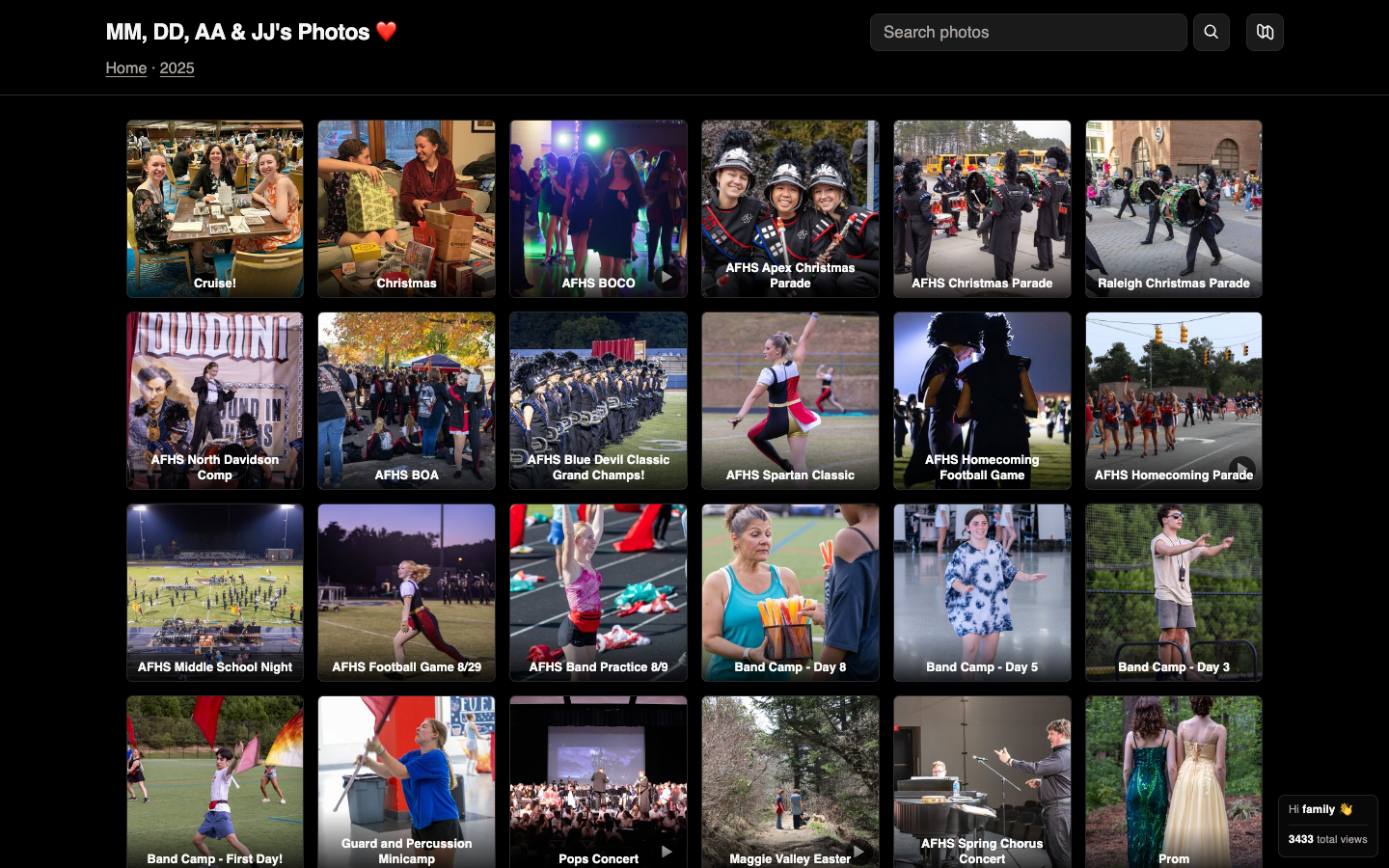
A private-by-design photo experience shaped around family memory instead of generic hosting. Not linked here because it is password-protected.
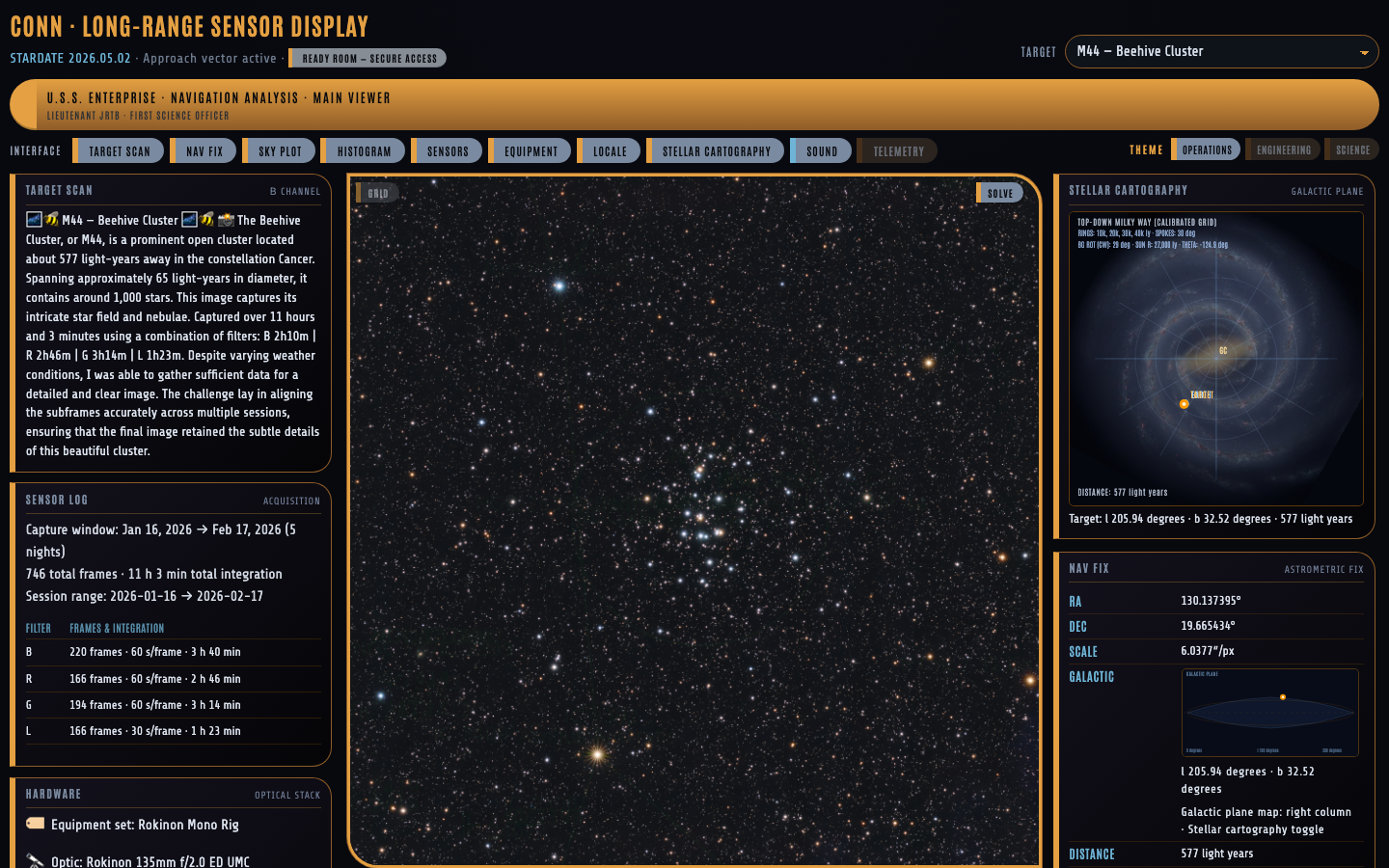
An expanding astronomy workspace for images, targets, planning, and exploration.
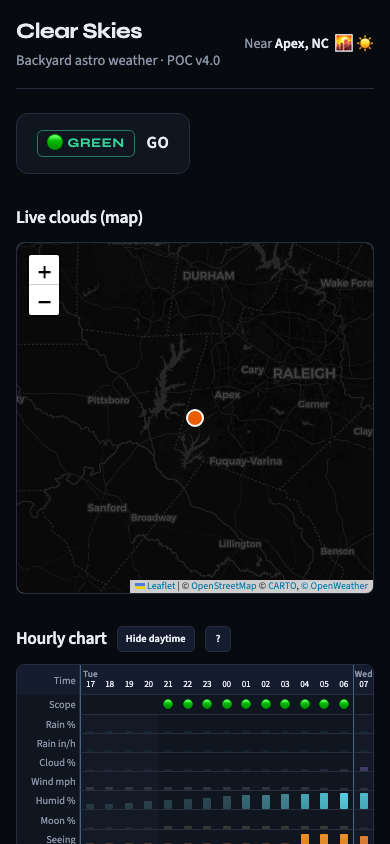
A go/no-go weather view for astrophotography nights.
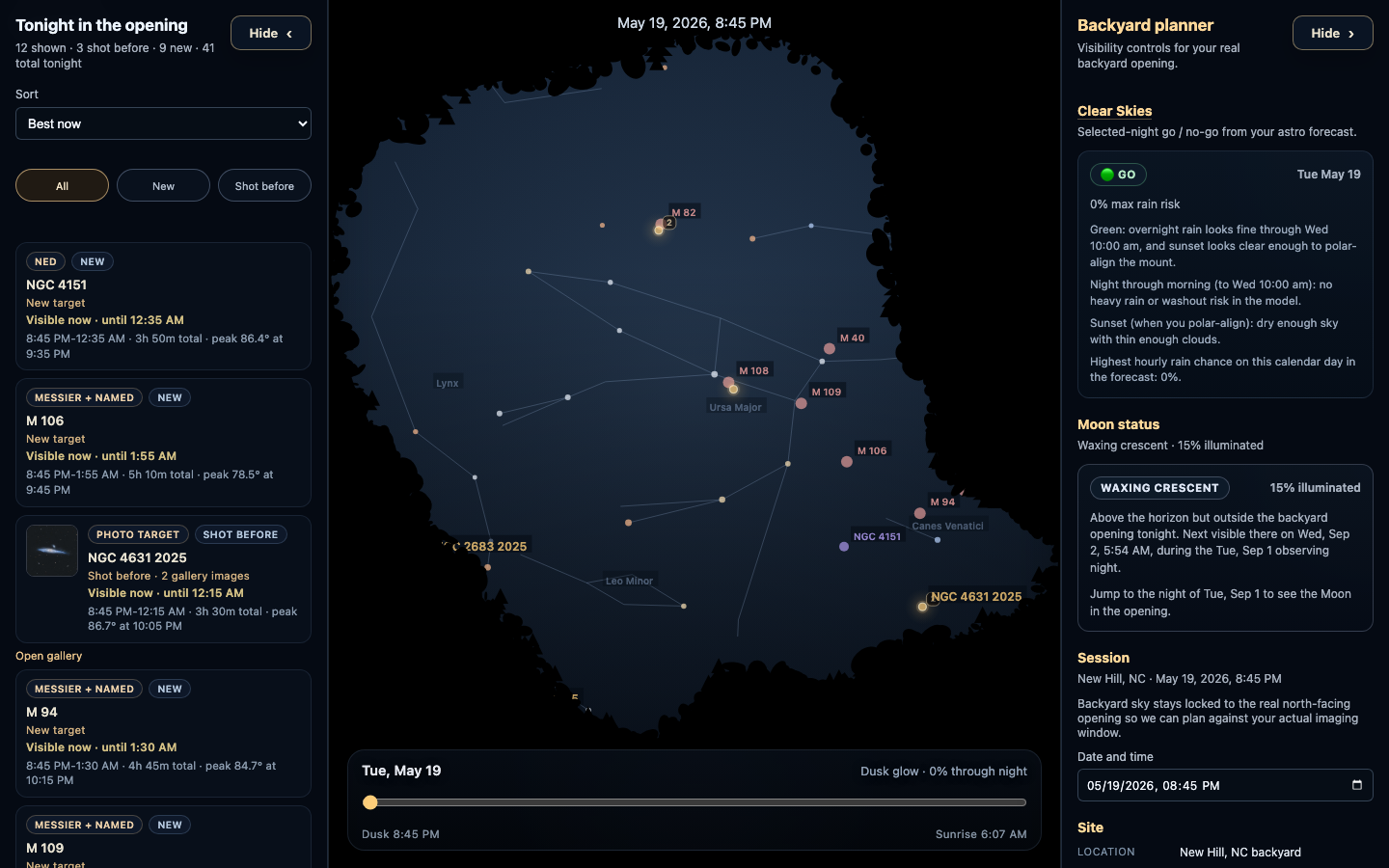
A sky planner tuned to my actual backyard opening, targets, weather, and session timing.
The subscription fatigue is real
We have normalized paying five, ten, twenty, or fifty dollars a month for every narrow slice of functionality. Sometimes that is worth it. Sometimes the service, community, reliability, and continued investment are exactly what we are paying for.
But many subscriptions occupy an awkward middle ground. They are too generic to fit perfectly, too expensive to ignore, and too sticky to leave once your data or habits accumulate there.
Agentic development creates a new option. Instead of asking "Should I subscribe?" we can ask "Is this useful enough to make mine?"
Instead of asking "Should I subscribe?" we can ask "Is this useful enough to make mine?"
The cost does not disappear. Tokens cost money. Hosting costs money. Maintenance is real. Security, backups, accessibility, and data ownership still matter. But the economics are different when the thing you are buying is not indefinite rent on a generic workflow, but the ability to create and keep a custom tool.
The agent is not the source of context
There is a tempting but incomplete story that AI builds the app for you. In practice, the leverage comes from pairing agents with lived context: what matters, what can be ignored, and what good enough actually means inside the workflow.
The agent can move quickly through implementation. It can inspect a codebase, generate a prototype, hook up a weather API, sketch a search index, refactor a gallery, or test a page. But it still needs a human operator who knows which decisions matter and which ones are noise.
For my projects, that means knowing which astrophotography weather signals actually matter. It means knowing how I browse old family photos. It means knowing why an object page needs capture details, why a sky map needs a certain kind of interaction, and why "beautiful" is not enough if the thing does not answer the night's practical question.
Agents compress the implementation loop. Domain context points that loop in the right direction.
This is not the end of SaaS
I do not think every product gets replaced by a personal app. Shared systems, payments, regulated workflows, collaboration networks, marketplaces, infrastructure, and community-heavy products still benefit from companies and platforms. Some software is hard because the problem is hard, not because the code is long.
The more interesting shift is at the edges: personal tools, family archives, hobby workflows, internal utilities, creative portfolios, lightweight research systems, custom dashboards, and small apps that would never justify a startup but absolutely justify existing.
That was always the spirit of personal computing.
The distance between wanting and making shrinks.
The next wave of custom software
The future of software will still include big platforms, polished SaaS suites, and apps built for millions. But I suspect it will also include far more small, personal, bespoke applications: software made by people who understand a niche because they live inside it.
That is the part that reminds me of BASIC, personal websites, and the early app explosion. Not because the technology is the same, but because the feeling is familiar. A new surface appears. The distance between wanting and making shrinks. People start building things that are too specific, too personal, or too odd to have survived a business case.
I am excited by that. I am also building into it. My own series of sites is a way to explore what happens when a person with enough domain context, enough curiosity, and a good agentic development loop starts reclaiming parts of their software life.
The next wave may not only be smarter tools. It may be software that is smaller, stranger, more personal, and much more ours.
Follow the experiment
I will keep publishing notes as these projects evolve, especially around the astronomy tools, family photo archive, Clear Skies, and the broader idea of personal software. The work is part product experiment, part field notebook, and part reminder that computers are still most interesting when they can be shaped around the people using them.